The Complete AZ-900 Guide: Exam, Study Plan, and Notes
A sourced AZ-900 guide: what the exam tests and weights, the cost, how to study, the concepts you need, and how it compares to the AZ-104 and AWS CLF-C02.
The AZ-900 (Microsoft Azure Fundamentals) is the entry-level exam that proves you understand cloud concepts, core Azure services, and Azure governance. This guide is the whole picture: what the exam actually tests and weights, what it costs, how to study for it, the concepts you need to know, and how it stacks up against the AZ-104 and the AWS equivalent. Every fact here is sourced.
What is the AZ-900, exactly?
The AZ-900 earns the "Microsoft Certified: Azure Fundamentals" credential by passing one exam, "Exam AZ-900: Microsoft Azure Fundamentals." It certifies foundational knowledge of cloud concepts, core Azure services, and Azure management and governance, and it has no prerequisites, so it is a common first step into the Microsoft cloud Microsoft Certified: Azure Fundamentals.
Here are the facts that matter, pulled from Microsoft's own pages:
- Time limit: 45 minutes to complete the assessment.
- Passing score: 700 on a scaled range of 1 to 1000. Microsoft is explicit that because the score is scaled, 700 does not equal 70 percent of questions correct; the required percentage varies by exam form how microsoft scores the exams.
- Cost: 99 dollars in the United States, varying by country and tax. The live price shows at checkout through AZ-900 portal.
- Expiry: it does not expire. Fundamentals certifications never need renewal, which is a real contrast with role-based certs like the AZ-104 that expire after a year Microsoft credential expiration policy.
- Question count: Microsoft does not publish it. Secondary sources disagree (some say 32 to 36, older ones say 40 to 60), so do not trust a specific number.
That last point is worth dwelling on. A lot of "AZ-900 guides" state a precise question count, a precise pass rate, and a precise salary as if they were facts. They are not published by Microsoft. Where this guide gives you a number, it tells you the source and how confident to be.

How the exam is weighted
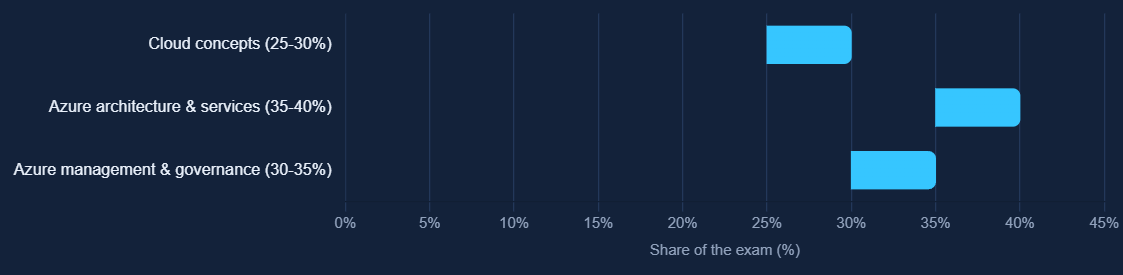
The exam is built from three skill areas. As of the January 14, 2026 version of the official study guide, the weightings are:
| Domain | Weight |
|---|---|
| Describe cloud concepts | 25-30% |
| Describe Azure architecture and services | 35-40% |
| Describe Azure management and governance | 30-35% |
Source: Microsoft AZ-900 study guide. Microsoft revises these periodically, so check the "skills measured as of" date on that page before you build a study plan around it which will be in the top right of the page.

The takeaway: the middle domain, core Azure architecture and services, is the largest single chunk. Spend your time there.
What does the AZ-900 actually cover?
It is broad and shallow. You need vocabulary and concepts across cloud fundamentals, core services, and governance, not deep hands-on skill. These are the areas to know.
Domain 1: cloud concepts (25-30%)
This domain is the theory of cloud computing itself. The skills measured break into three groups:
- Cloud computing: define cloud computing, the shared responsibility model, the public, private, and hybrid cloud models and when to use each, the consumption-based model, how cloud pricing models compare, and serverless.
- Benefits of cloud services: high availability and scalability, reliability and predictability, security and governance, and manageability.
- Cloud service types: IaaS, PaaS, and SaaS, and the right use case for each.
| Model | What it is | Why you would pick it |
|---|---|---|
| Public | Owned and run by Microsoft, delivered over the internet | Pay-as-you-go, no hardware to maintain, scales fast, go global in minutes |
| Private | Traditional on-premises, your own datacenter and virtualization | Full control, strict security or compliance, legacy apps |
| Hybrid | Public and private combined, sharing data and apps | Run in the cloud while keeping sensitive or legacy workloads on-prem |
Think of cloud computing like this renting resources (CPU, RAM, storage) from a provider a.k.a. using someones elses computers and paying only for what you use instead of buying your own. The pitch, and a likely exam point, is simple: no large upfront hardware cost, no long provisioning time (days and weeks, some deployments can take a few hours depending on the size and what you are deploying), you size resources to the job, and you can run one or many with little extra effort. The three deployment models are the classic exam comparison:
Service models: IaaS, PaaS, SaaS
The other comparison the exam loves is who manages what:
| Model | You manage | Example |
|---|---|---|
| IaaS | The OS and up; you rent the infrastructure | A virtual machine |
| PaaS | Just your app; the platform handles the rest | Azure App Service |
| SaaS | Nothing but how you use it | Gmail |
One cost distinction sits here too: CapEx is money spent upfront with value written down over time; OpEx is pay-as-you-use with no upfront cost. Economies of scale are why a provider can offer a lower per-unit cost than you can reach alone. Companies you will be working at will like this OpEx model more then CapEx in most cases. Think of it likes this instead of buying a server and licenses for 20k upfront they pay that 20k over 3 years which breaks down to roughly $555 dollars per month. OpEx can usually be dedcuted immediatly for tax purposes while CapEx depreciates over time. This is just a simple example of why compaines perfer the Cloud over traditonal on premises deployments that they have been doing for years.
Domain 2: Azure architecture and services (35-40%)
This is the largest domain, and the one most people underestimate, because it asks you to identify specific Azure services by name. The skills measured cover four areas:
- Core architectural components: Azure regions, region pairs, and sovereign regions; availability zones; datacenters; resources and resource groups; subscriptions; management groups; and the hierarchy that ties resource groups, subscriptions, and management groups together. A region is a set of low-latency datacenters, a geography is a market of two or more regions that preserves data residency, availability zones are physically separate datacenters within a region, and region pairs provide disaster recovery if a whole region goes down.
- Compute and networking: the compute types (containers, virtual machines, and functions); VM options such as Azure VMs, Virtual Machine Scale Sets, availability sets, and Azure Virtual Desktop; application hosting options (web apps, containers, VMs); and virtual networking, including virtual networks, subnets, peering, Azure DNS, VPN Gateway, ExpressRoute, and the difference between public and private endpoints.
- Storage: how the Azure Storage services compare, storage tiers, redundancy options, storage account types, the tools for moving files (AzCopy, Azure Storage Explorer, Azure File Sync), and the migration options (Azure Migrate and Azure Data Box).
- Identity, access, and security: Microsoft Entra ID and Microsoft Entra Domain Services; authentication methods (single sign-on, multifactor authentication, passwordless); external identities; Conditional Access; role-based access control (RBAC); Zero Trust; defense in depth; and Microsoft Defender for Cloud. On identity, the layered model runs user, then password or passwordless, then MFA, then Conditional Access. Zero Trust assumes every request is untrusted until verified, and defense in depth layers security from the physical datacenter up through identity and data.
Domain 3: Azure management and governance (30-35%)
The final domain is about running and controlling an Azure estate. The skills measured cover three areas:
- Cost management: the factors that affect cost, the Pricing Calculator, the cost management tools, and the purpose of tags.
- Governance and compliance: Microsoft Purview, Azure Policy, and resource locks. For governance scope, memorize the hierarchy: Management Group, then Subscriptions, then Resource Groups, then Resources. Its not complex but it is important.
- Monitoring: Azure Advisor, Azure Service Health, and Azure Monitor (including Log Analytics, alerts, and Application Insights).

How should you study for the AZ-900?
Here is what worked for me. I used two resources together and one habit that mattered more than either of them: a free video cram over the whole blueprint, a structured learning path for the same material at a slower pace, and a practice exam every single day, then I went back and drilled the areas I was weak on. Rinse and repeat. The daily practice exam was the part that moved the needle. Watching videos builds recognition; answering questions every day builds recall under exam conditions. However actually logging into Azure is what builds the skill not just videos and learning paths.
For free, official material, start with Microsoft's own resources, sometimes Microsoft Learn is all you need:
- The Microsoft Learn AZ-900 learning path (free)
- The official free practice test to get used to Microsoft's question style
- A widely used free community study guide, the open-source Azure AZ-900 Study Guide on GitHub (community-maintained, so check it is current)
How long does it take?
Microsoft does not publish a study-time estimate, so the numbers below are commonly cited ranges from training providers, not official figures. Treat them as a guide, not a guarantee.
| Your background | Commonly cited prep time |
|---|---|
| New to IT and cloud | ~40-60 hours, 4-6 weeks |
| Some general IT experience | ~25-35 hours, 2-3 weeks |
| Existing cloud experience | ~15 hours, 1-3 weeks |
Ranges adapted from training-provider consensus DiviTrai, MSCertQuiz; no primary Microsoft source exists for study hours. I did it in two and a half months studying one hour a day and taking a practice exam every day however someone could very easily do it quicker than that.
| Week | Focus | Why |
|---|---|---|
| 1 | Cloud concepts (25-30%) | Lightest domain; build the vocabulary first |
| 2-3 | Azure architecture and services (35-40%) | Largest domain; split across two weeks for the named services |
| 4 | Management and governance (30-35%), then the free practice assessment and review | Lock in governance, then drill questions |
Compress this if you already have cloud experience! The point is to weight your time by the blueprint, then spend the last stretch on daily practice questions. However the most effective way I have found to study is take a practice exam daily! Either Pluralsight or Microsoft learn then review that in a lab by trying to build what is talked about and then review documentation and videos to supplement not the other way around.
Can you get it cheaper?
The fully free exam voucher that used to come from Microsoft's Azure Virtual Training Days was discontinued (reported in 2023). The current benefit is a 50 percent discount for attendees who complete both parts of the free virtual event, applied at checkout. Terms change, so confirm them on the live Microsoft Virtual Training Days page before you rely on it.
The resources I used, and others worth knowing
- John Savill's AZ-900 Study Cram for a fast, complete pass over what you will be tested on**.
- Pluralsight's** AZ-900 Learning Path and Microsoft Learns AZ-900 Learning Path for the same material at a slower, more structured pace.- A practice exam every single day, pulling questions from Pluralsight Pluralsight Practice Test and the Microsoft Learn Practice Test**.
Free, official material worth starting with
- The Microsoft Learn** AZ-900 Learning Path (free).
- The official free practice test t**o get used to Microsoft's question style.
Other resources worth knowing (that I did not use)
I did not personally use these, but they are solid options worth knowing about:
- Udemy:** Scott Duffy's AZ-900 Microsoft Azure Fundamentals Exam Prep, a long-running and popular paid video course aimed squarely at the exam. (This is not free)- **Community study guide:** the open-source [AZ-900 Study Guide on Github (community-maintained, so check it is current before relying on it).**
- Note-taking apps:** I take my condensed exam notes in a dedicated app, and two are excellent for it: Notejoy and Obsidian. Obsidian stores everything as local Markdown files, which is ideal if you want to own your notes; Notejoy is faster for quick capture and sharing. Condensing the blueprint into your own notes is one of the highest-value study habits there is. (Note I am not paid to recommend this tools I just use them cause they are helpful). The way I take notes is like this, practice test what did I score? Write that in Notes and repeat this every day. Is the score going up or down and in what domain? Ok I needs to study that. Then rinse and repeat all the way up until the exam. Its not about being perfect its about passing the exam so focus on the areas you struggle with and you will pass.
Should you take the AZ-900 or skip to the AZ-104?
This is the most common real question, and the honest answer is "it depends on your experience."
| Attribute | AZ-900 | AZ-104 |
|---|---|---|
| Level | Fundamentals (entry) | Associate |
| Nature | Theory and concepts, no hands-on required | Hands-on administration skills |
| Prerequisites | None | None required, but Azure experience is strongly assumed |
| Expiry | Never expires | Expires after one year (renew free online) |
| Audience | Newcomers, career changers, cloud-adjacent roles | Aspiring and working Azure administrators / Engineers |
Sources: AZ-104 certification page, Microsoft expiration policy. The AZ-104 exam price (about 165 US dollars) should be confirmed at checkout. That is how much it cost me when I took the exam.
The case to skip straight to AZ-104: if you already have one to two years of hands-on cloud or Azure exposure, the AZ-900 is theory you absorbed long ago, and the standalone fundamentals cert will not move the needle at associate level Training Camp. The case to start with AZ-900: if you are genuinely new to cloud, it builds the vocabulary and concept map that makes AZ-104 far less painful, for a small extra cost. Many people take both, in order. Also one thing to note you might be able to work out a deal with your current employee to get them to pay for the exam however that is something you would have to ask them about its always worth a shot though.
What about AWS instead? AZ-900 vs the Cloud Practitioner?
If you are not tied to Microsoft, the AWS Certified Cloud Practitioner (CLF-C02) is the obvious alternative at the same level. The hard facts, from AWS's own exam guide:
| Attribute | AZ-900 | AWS CLF-C02 |
|---|---|---|
| Cost (USD) | $99 | $100 |
| Questions | Not officially published | 65 (50 scored) |
| Duration | 45 min | 90 min |
| Passing score | 700 / 1000 (scaled) | 700 / 1000 (scaled) |
| Validity | Does not expire | 3 years (verify) |
Sources: AWS Certified Cloud Practitioner, and the Official AWS Exam Guide; AZ-900 facts as above.
Which one is "better" depends on where you are headed, not on the cert itself. AWS is the cloud market leader (about 32 percent of global cloud infrastructure spend in Q4 2025, with Microsoft Azure the clear second) according to Omdia, so CLF-C02 is the natural pick if your target employers or current stack are AWS-centric. AZ-900 is the better pick if you work in a Microsoft shop (Windows Server, Microsoft 365, Entra ID) or target Azure roles. AZ-900 is marginally cheaper, shorter, and never expires; CLF-C02 covers more raw service breadth and expires after three years.
This is my opinion on the topic of Azure vs AWS get certified in both and use both. Start with one and then branch out so many of the topics are interchangable and while how some the features work will be different it is not that drastic of a change. Here is an exampe of a Service mapping of AWS to Azure. Learn both don't let someone tell you that they are drastically different they are not.
Is the AZ-900 worth it?
My opinion: NO! a fundamentals cert can be necessary but is not sufficient! It is low cost against a bootcamp or a college credit, "Azure Fundamentals" is a common keyword filter on entry-level cloud job listings, and it is a genuine confidence builder and concept scaffold for career changers and non-engineering roles Coursera. Against that: the cert alone rarely lands a job, and a working cloud engineer should skip it or if you have other technically knowledge say you have the CompTIA A+ or the CCNA don't waste your time on this do the AZ-104 I didn't learn much if anything from this exam however if you are changing careers or are coming from a non-technical background i.e. have never worked in tech then yes! This cert will be good for you.
On salary, be skeptical of anyone quoting a precise "AZ-900 salary." A foundational cert is not a job, and the figures floating around (anywhere from roughly $65K to $153K) come from aggregator-citing training sites with no consistent methodology. Treat them as loose, role-adjacent ranges, not a number this cert pays you. Honestly I didn't get paid more of having the AZ-900 and I would not expect you to get paid more cause of it either.
What is the exam like on the day?
You take the AZ-900 online with a proctor or at a test center, and the 45 minutes covers a mix of question types. Microsoft notes the exam can include interactive components and gives you a sandbox to preview them Microsoft Learn.

Practical advice from sitting it: log in 30 to 45 minutes early, follow the proctor's directions exactly, and let your preparation carry the rest. If you ran daily practice exams, the format will already feel familiar before you read a single question.
What if you fail? The AZ-900 retake policy
Failing is recoverable, and the rules are fixed Microsoft Retake Policy:
- After a first failure, you must wait 24 hours before retaking.
- After that, there is a 14 day wait between each subsequent attempt.
- You can attempt the exam no more than 5 times in a 12 month period, counted from your first attempt.
- You pay the exam fee for each attempt; there is no discounted retake.
A waiting-period waiver exists only for documented Pearson VUE connectivity or equipment problems with a case number.
Key terms
A fundamentals exam is vocabulary-heavy, so it pays to be fluent in the core terms. Each of these maps to a topic in the Microsofts offical study guide and its linked Microsoft Learn modules:
What is CapEx vs OpEx?
Capital expenditure (upfront fixed-asset spend) versus operating expenditure (ongoing pay-as-you-go cost); cloud shifts spend toward OpEx.
What is a Consumption-based model?
You pay only for the resources you use, when you use them.
What is the Shared responsibility model?
Security and management duties split between Microsoft and the customer, varying by IaaS, PaaS, and SaaS.
What is IaaS / PaaS / SaaS?
The three cloud service types, differing in how much the provider manages.
What is Public / Private / Hybrid?
The three deployment models.
What is Region and Region Pair?
A region is a set of nearby datacenters; a region pair links two regions in the same geography for resilience.
What is an Availability Zone?
Physically separate datacenters within a region, each with independent power, cooling, and networking.
What is a Resource Group?
A logical container for related Azure resources.
What is a Subscription?
A billing and access-management boundary that holds resource groups.
What is a Management Group?
A container above subscriptions for applying governance at scale.
What is Microsoft Entra ID?
Microsoft's cloud identity and access management service (formerly Azure AD).
What is RBAC?
Role-based access control; grants access by assigning roles to identities at a scope.
What is Conditional Access?
A policy engine that grants or blocks access based on signals such as user, device, location, and risk.
What is MFA / SSO / Passwordless?
Multifactor authentication, single sign-on, and passwordless authentication methods.
What is Zero Trust?
A security model that assumes a breach and verifies every request explicitly.
What is Defense in depth?
Layered security controls so no single failure is catastrophic.
What is Microsoft Defender for Cloud?
Cloud security posture management and workload protection.
What is Azure Policy?
It enforces organizational rules and compliance on resources.
What is a Resource lock?
It prevents accidental deletion or modification of a resource.
What is Microsoft Purview?
It is data governance and compliance across the Azure estate.
What is Azure Advisor?
Personalized recommendations across cost, security, reliability, performance, and operational excellence.
What is Azure Service Health?
Service issues, planned maintenance, and health advisories affecting your resources
What is Azure Monitor:?
The telemetry platform, including Log Analytics, alerts, and Application Insights.
What is an SLA?
A service-level agreement, Microsoft's uptime or performance commitment for a service.
What is TCO and the Pricing Calculator?
Total Cost of Ownership compares on-premises against cloud cost; the Pricing Calculator estimates Azure cost.
What is next?
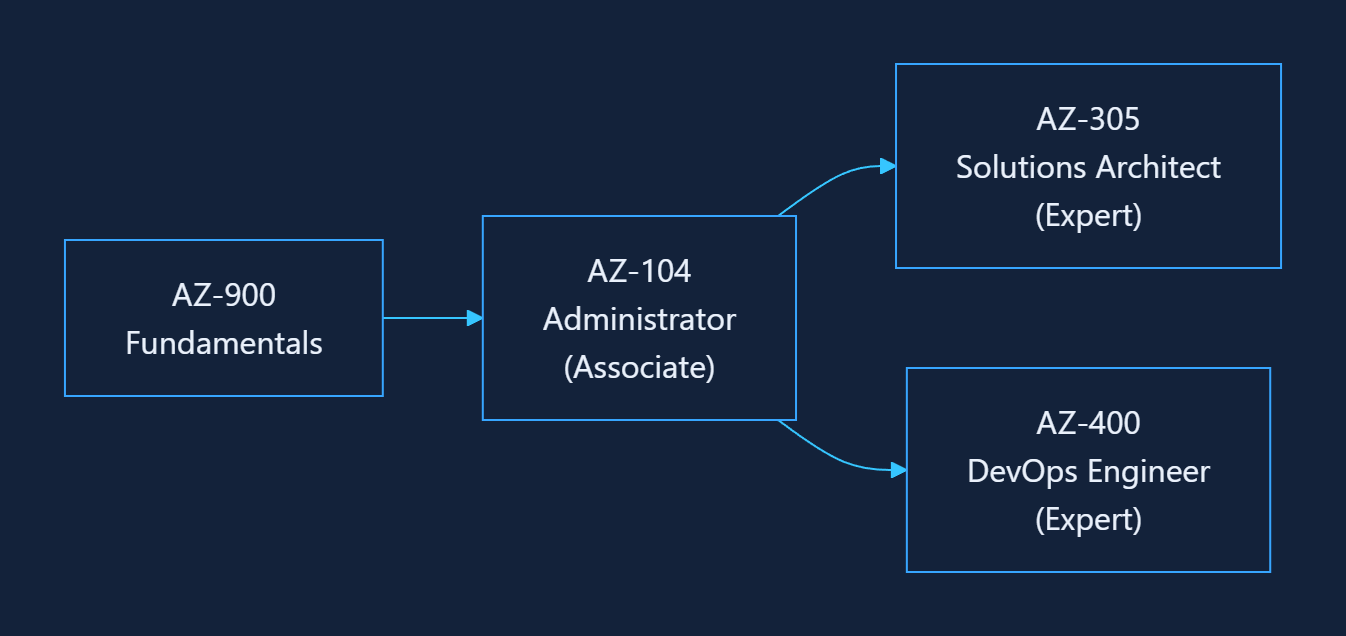
The AZ-900 is step one. The natural next move is the AZ-104 Azure Administrator exam, which is more hands-on. Treat the AZ-900 as the foundation it is: prove the concepts, get the vocabulary, then go build something real.